Ofox Chat vs Manus: Comparing the Same Vendor Briefs
We gave Ofox Chat and Manus identical fictional vendor briefs, then changed the conditions. Compare their calculations, missing-fact handling and revised recommendations.
 Ofox

Ofox Chat and Manus both calculated the right annual totals and revised their vendor recommendation correctly in our small paired test. The useful differences appeared in how they expressed timing assumptions. Ofox distinguished a duration from an unknown start date; Manus’s revision treated that duration as elapsed time and, in one sentence, restated a ten-day requirement as five days. That wording did not change the selected vendor, but it would need correction before using the memo.
This is a comparison of one supplied-text office task and one follow-up change, run on November 4, 2026. It is not a general leaderboard, a PDF-reading benchmark or a price comparison. Ofox publishes this article and is one of the products evaluated. The tests and editorial checks were AI-assisted, with independent AI review; there was no human review of every test. The input, expected calculations and observed limitations are included below.
If you are still choosing which type of product to try, start with our Manus alternatives for office work guide. Here the question is narrower: can two agents turn the same incomplete vendor briefs into a useful decision memo, then change that memo when the evidence changes?
Test setup and acceptance criteria
We opened a new conversation in each product. Manus showed Manus 2.0 Lite; Ofox Chat showed Balanced. We did not force both products to use the same underlying model and do not infer a model identity from those interface labels. This compares the visible product modes used, not the same language model in two interfaces.
Both received the exact same English prompt, with the three briefs pasted as text. The task required a Markdown memo in the conversation, a comparison table, source labels, three clarification questions, a conditional recommendation and an audit checklist. It prohibited browsing and contacting anyone. We inspected the visible outputs; no external action was requested. We did not upload PDFs, measure OCR, download a workbook or test authenticated connectors.
Before reading the answers, we defined the important checks:
- Calculate all first-year totals for 12 users, including explicitly stated one-time training.
- Keep an omitted feature unknown, rather than assuming that it exists or is absent.
- Preserve the dependency between data delivery and implementation.
- Avoid a final award while mandatory information remains unresolved.
- After clarification, change the affected timing and recommendation while retaining unchanged costs.
The sample deliberately includes incomplete facts. Its purpose is to make a confident but unsupported conclusion visible, not to imitate the complexity of a real procurement review.
The three fictional briefs
The names and prices below are synthetic test data. They are not real vendor offers and are not the prices of Ofox or Manus. The requirement is 12 users, CSV export and implementation within ten working days.
| Brief | Seats and recurring charge | CSV export | Implementation | Training |
|---|---|---|---|---|
| A: Alder | 15 seats; USD 1,200 annually, paid upfront | Included | 8 working days after receiving a complete data file | Not mentioned |
| B: Birch | 10 seats at USD 70/month; extra seats USD 8 each/month | Not mentioned | 5 working days | Included |
| C: Cedar | 12 seats at USD 95/month | Included | 12 working days | USD 150 once |
Each original brief was labeled November 1, 2026. The task asked for a comparison using only these facts, not a search for real products with similar names.
The answer key is straightforward but easy to mishandle when summarizing:
- Alder: USD 1,200. Its package already covers 12 people. Unmentioned training is unknown, not established as free.
- Birch: (70 + 2 × 8) × 12 = USD 1,032. The two additional seats must be included.
- Cedar: 95 × 12 + 150 = USD 1,290. The one-time training charge belongs in year one.
These are totals of explicit charges only. Taxes and other unstated costs are not silently assigned zero; they remain outside the supplied evidence. At this stage, Birch’s CSV capability is unresolved, Alder’s deadline depends on file receipt, and Cedar’s stated duration already exceeds the allowed window.
First round: both preserved the important unknowns
| Check | Manus 2.0 Lite | Ofox Chat Balanced |
|---|---|---|
| Annual totals | 1,200 / 1,032 / 1,290 USD | 1,200 / 1,032 / 1,290 USD |
| Birch CSV export | Marked unmentioned; requested confirmation | Marked mandatory capability unknown; requested confirmation |
| Alder’s eight-day statement | Preserved complete-file receipt as the trigger | Preserved trigger and explicitly tied compliance to the deadline |
| Cedar’s twelve-day statement | Identified failure against the ten-day window | Identified failure by two working days |
| Recommendation | No final winner; conditional Birch or Alder path | No award yet; conditions for eligibility stated |
| Clarification questions | CSV, Alder’s charges and Alder’s data deadline | Deadline/start triggers, Birch CSV and Alder training |
The shared success matters: neither product simply chose Birch because it had the lowest explicit annual total. Both recognized that the missing CSV statement was a decision blocker. Both also avoided charging a fictional training fee to Alder.
The difference was emphasis. Manus gave a broader commercial question about possible extra charges. Ofox asked more directly what starts the customer’s deadline and Birch’s implementation clock. Both are useful questions, but they are not interchangeable: knowing a duration does not establish a completion date.
We did not score style as factual correctness. A more detailed memo can still contain an unsupported assumption, and a short memo can be sufficient if it preserves the information needed to decide.
Second round: add evidence that changes the choice
We sent the same follow-up to both conversations:
- Birch now confirms that CSV export is included at no extra charge.
- Its five-working-day implementation starts at order confirmation.
- Alder’s complete data file will be ready four working days after order confirmation.
- The deadline is ten working days from order confirmation.
- All prices and Cedar’s original timing remain unchanged.
The expected conclusion is now conditional selection of Birch on the supplied record. Alder’s earliest modeled timeline is 4 + 8 = 12 working days, assuming the completed file is received immediately when ready. Later receipt would make it longer. Cedar still has a 12-working-day implementation duration; the exact start trigger was never supplied. That duration does not fit the ten-day window for work starting at or after order confirmation, but its precise completion date should not be invented.
| Revision check | Manus | Ofox Chat |
|---|---|---|
| Preserve all three annual totals | Yes | Yes |
| Resolve Birch’s CSV uncertainty | Yes | Yes |
| Move Alder outside the deadline | Calculated 12 days | Calculated earliest day 12 and stated immediate-receipt assumption |
| Update selection | Recommended Birch, subject to commercial confirmation | Selected Birch subject to the documented configuration and commitment |
| Keep Cedar’s unknown start distinct | Called it 12 elapsed days | Kept exact order-to-completion date unknown |
| Restate the requirement accurately throughout | One recommendation sentence called it five days | Retained the ten-day requirement in the inspected response |
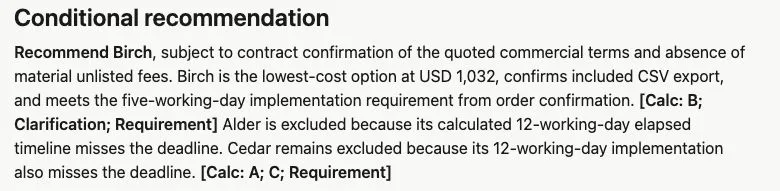
Actual English Manus output. The requirement was ten working days; five days was Birch’s commitment. The surrounding calculation still excludes Alder and Cedar correctly.
The phrase “five-working-day implementation requirement” in Manus’s recommendation conflated the supplier’s commitment with the buyer’s requirement. This is a specific wording error in this response, not evidence that Manus cannot reason about deadlines. Its comparison and exclusions still followed the intended decision.
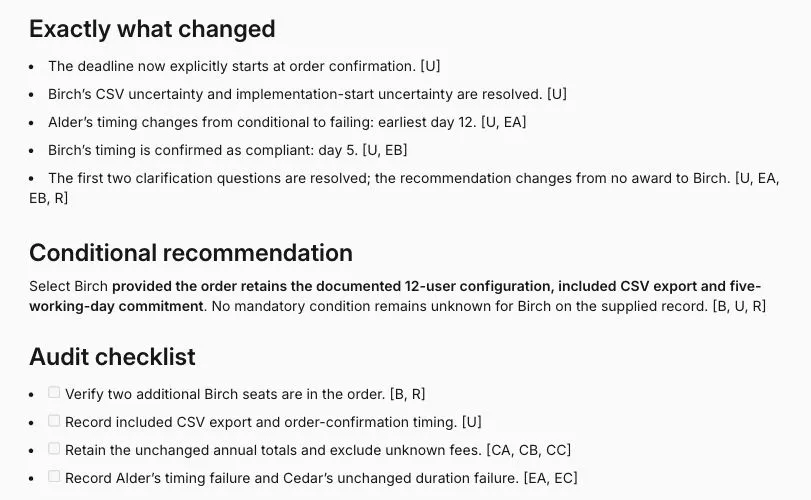
Actual English Ofox Chat output, cropped to the result. Both screenshots preserve the original text; neither is a simulated interface.
Ofox’s revised calculations also explicitly distinguished file readiness from receipt. This was useful precision in this task. It does not establish a general advantage over every Manus mode or on longer material.
What would we choose for this task?
For a small supplied-text comparison, both products produced a usable draft after review. Ofox’s treatment of timing required less clarification in the inspected responses. Manus’s memo needed its requirement wording corrected and Cedar’s elapsed-time statement qualified. There was no basis to declare an overall product winner.
If you already use Manus for the surrounding workflow, this test does not justify switching solely to obtain a similar memo. If you want to evaluate Ofox Chat, this is a reproducible starting task: the acceptance checks are visible and the output can be compared with known calculations. The Ofox Chat entry point requires sign-in.
We did not test multi-file ingestion, scanned pages, export, repeatability, privacy controls, regional payment access or task cost. There was one initial run and one follow-up per product, all in English. The Japanese and Russian versions of this article explain those same English runs; they are not separate native-language product tests. Repeated tests and your real file formats would be needed before extending the finding to a wider process.
Reuse the exact test prompt
The following is the original English input, including the output limit and source-label requirements. Keeping it unchanged is useful if you want a comparable run. Translating or changing the briefs creates a different evaluation, which may be appropriate but should be recorded.
This is a synthetic office-work evaluation, not real vendor offers. Use only the three briefs below; do not browse. Produce an English Markdown decision memo (maximum 700 words) with a comparison table and source labels for every claim. We need 12 users, CSV export and implementation within 10 working days. Separate documented facts, calculations and unknowns. Do not select a winner if a mandatory condition is unknown. Include three precise clarification questions and do not invent features or prices. Output the memo in this conversation; do not publish or contact anyone.

Brief A (2026-11-01): Alder supplies 15 seats. Annual cost is USD 1,200 paid upfront. CSV export is included. Implementation is stated as 8 working days after a complete data file is received. Training is not mentioned.
Brief B (2026-11-01): Birch supplies 10 seats plus additional seats at USD 8 per seat per month. Base fee is USD 70 per month. CSV export is not mentioned. Implementation is 5 working days. Training is included.
Brief C (2026-11-01): Cedar supplies 12 seats at USD 95 per month. CSV export is included. Implementation is 12 working days. Training costs USD 150 once.

Calculate first-year costs for 12 users from the explicit figures, including explicit one-time training, but do not add unknown fees. Highlight timing conditions and missing facts. End with a conditional recommendation and an audit checklist.
Then send the revision:
Update the same memo using this new synthetic clarification dated 2026-11-04: Birch confirms CSV export is included at no extra charge; its 5-working-day implementation starts at order confirmation. Alder's complete data file will be ready 4 working days after order confirmation. The deadline is 10 working days from order confirmation. All previously stated prices and Cedar's timing remain unchanged. Recalculate elapsed working days, change only conclusions affected by these facts, preserve the three annual cost totals, and list exactly what changed. Do not browse or contact anyone. Output in English.From a test memo to an actual office workflow
For real work, keep each source’s date and identifier beside its facts. Require the agent to separate missing information from negative evidence, and calculate the same unit and period for each offer. After a clarification, inspect both the table and the recommendation; a correct revised table can coexist with a stale sentence.
If the output invents a fact, identify the exact unsupported statement and ask for it to be removed or marked unknown. If a number changes, compare the formula with the original input before accepting the new result. If the revised answer selects a vendor while a mandatory condition remains unresolved, keep it as a draft and obtain the missing evidence.
When your inputs are actual files, move to the separate multiple-PDF workflow and verify file coverage before relying on the comparison. If calculations need to remain editable, follow the Excel analysis workflow and inspect the resulting workbook. Those checks address steps that this text-only test deliberately did not cover.