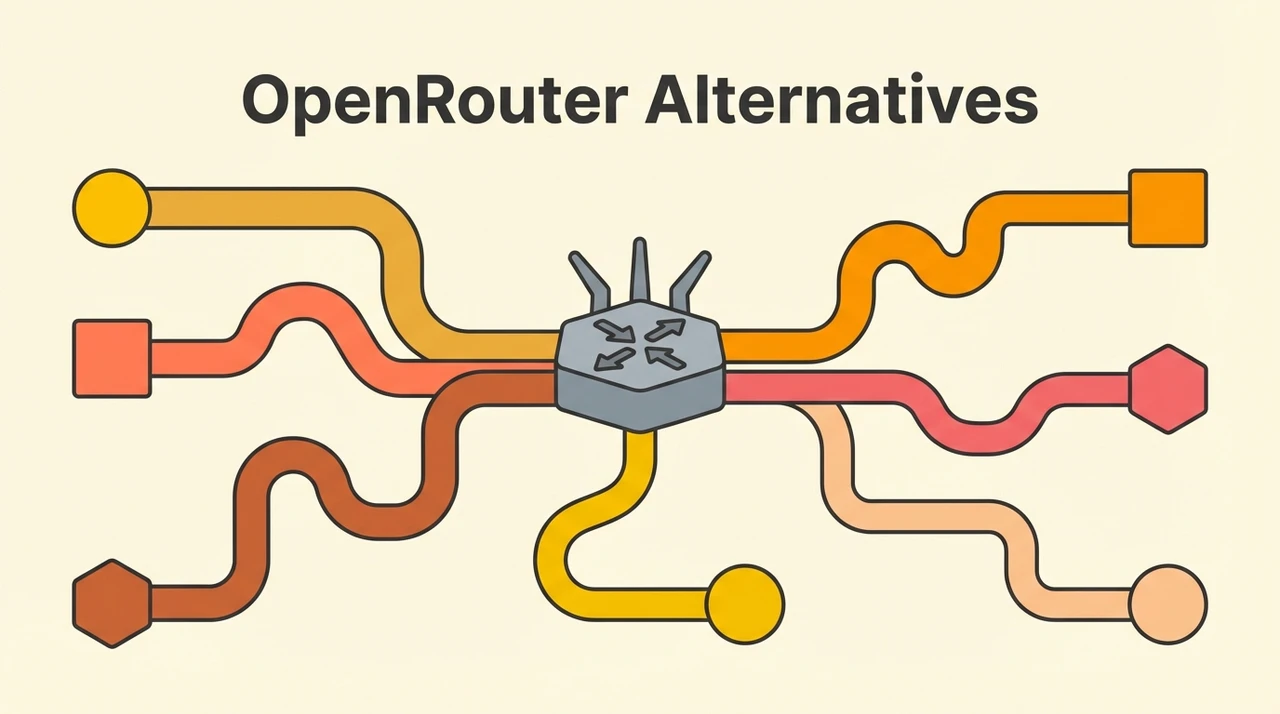
7 Best OpenRouter Alternatives in 2026: Pricing & Migration

Compare Ofox, Together AI, Fireworks AI, LiteLLM, Portkey, and more on pricing, latency, and OpenAI SDK compatibility — with migration code examples.

7 Best OpenRouter Alternatives in 2026: Pricing & Migration

Pricing update (2026-08-17): DeepSeek moved the whole V4 family to peak/off-peak billing at 16:00 UTC on 2026-08-16. The DeepSeek rates quoted on this page are from before that change. Current rates, the multiplier on each tier, and the peak-hour windows are in DeepSeek API Price Increase.

Key Takeaways

  • OpenRouter charges a 5.5% fee on credit purchases (non-crypto), has no public SLA, and documents ~25–40ms of gateway overhead — fine for prototyping, but the fee compounds at scale.
  • If you want a drop-in replacement with zero purchase fees and three native SDK protocols (OpenAI, Anthropic, Gemini), Ofox is the closest alternative.
  • If you run open-source models and want the lowest per-token cost, Together AI and Fireworks AI are inference providers that cut out the middleman.
  • If you need full control, LiteLLM is a free, open-source gateway you self-host — zero markup, zero vendor lock-in, but you manage the infrastructure.
  • Every alternative in this guide supports the OpenAI SDK — migration is a two-line code change.

Why Developers Look for OpenRouter Alternatives

OpenRouter popularized the idea of a unified LLM API — one key, hundreds of models. It’s a great starting point. But as projects grow, several pain points emerge:

The 5.5% Credit Purchase Fee

OpenRouter charges a 5.5% fee on every credit purchase (non-crypto), with a minimum of $0.80 per transaction. Crypto payments have a 5.0% fee with no minimum.

While OpenRouter states they don’t mark up inference pricing, this purchase fee is effectively a surcharge on all usage. At $1,000/month in API spend, you’re paying $55/month just in fees — $660/year. (For the complete fee-stack including the BYOK 5% kicker, see our OpenRouter pricing breakdown 2026.)

No Public SLA

OpenRouter’s Terms of Service explicitly disclaim uptime guarantees. Section 16:

“THE OPENROUTER ENTITIES DO NOT WARRANT THAT THE SERVICE OR ANY PORTION OF THE SERVICE … WILL BE UNINTERRUPTED, SECURE, OR FREE OF ERRORS, VIRUSES, OR OTHER HARMFUL COMPONENTS, AND DO NOT WARRANT THAT ANY OF THOSE ISSUES WILL BE CORRECTED.”

They also reserve the right to “modify or discontinue the Service at any time … without notice to you.” Liability is capped at the greater of $100 or 12 months of payments. Enterprise SLAs exist but require negotiated agreements.

For production applications where downtime means lost revenue, this is a significant risk. For a detailed breakdown of OpenRouter’s outage history and what it means in practice, see Is OpenRouter Reliable? An Honest Review.

Latency Overhead

OpenRouter’s documentation cites ~25ms ideal and ~40ms typical overhead. Treat that as the floor rather than the number you will see: any hop through a gateway adds a network leg, and reported figures from third parties run higher. One third-party review puts real-world overhead at 100–150ms and records 742ms through OpenRouter against 622ms direct to Vertex AI — a single blog’s measurement, not a controlled benchmark, so treat it as directional.

Any gateway pays this tax, including the alternatives here. The question is not whether overhead exists but whether tens of milliseconds matter for what you are building. For chat interfaces it rarely does. For voice agents, trading bots, or anything with a human waiting on first token, measure it yourself against your own region before you commit.

Credit Expiration

OpenRouter’s Terms reserve the right to expire unused credits 365 days after purchase (§4.2). Refunds have loosened since this guide first ran: §4.1 now describes a refund button on the Credits page that returns the unused credit amount, with platform fees non-refundable and crypto payments never refundable. If your usage fluctuates seasonally, the expiry clause is still the one to watch.

The Alternatives: A Practical Comparison

Not all alternatives are the same type of product. Understanding this distinction is critical:

  • API aggregators (like OpenRouter) host no models — they route your requests to providers and charge a fee.
  • Inference providers (Together AI, Fireworks AI) actually run models on their own GPU clusters — you pay per token with no middleman markup.
  • Gateway/proxy tools (LiteLLM, Portkey, Helicone) sit between your app and any provider — you bring your own API keys and pay providers directly.

Quick Comparison

PlatformTypePurchase FeeSLAOpenAI SDKSelf-HostBest For
OpenRouterAggregator5.5%None (public)YesNoPrototyping, model exploration
OfoxAggregatorNone99.9% (Pro)YesNoProduction apps, multi-protocol
Together AIInferenceNoneN/AYesNoOpen-source models, fine-tuning
Fireworks AIInferenceNoneN/AYesNoLow-latency inference
LiteLLMGateway (OSS)NoneN/AYesYesFull control, self-hosted
PortkeyGatewayNoneN/AYesYesEnterprise observability
HeliconeObservabilityNoneN/AYesYesLogging and analytics

Head-to-Head: OpenRouter vs Ofox vs LiteLLM vs Portkey

If you’re evaluating gateways today, these four represent the spectrum from “managed aggregator” to “fully self-hosted.” Here’s how they stack up on the numbers that matter in production:

OpenRouterOfoxLiteLLM (OSS)Portkey
Purchase / platform fee5.5% on creditsNoneNone (self-hosted)$49/mo (Production)
Claude Sonnet 5 (1M input)$2.00 + 5.5% fee$2.00$2.00 (direct to Anthropic)$2.00 + platform fee
GPT-5.6 Sol (1M input)$5.00 + 5.5% fee$5.00$5.00 (direct to OpenAI)$5.00 + platform fee
DeepSeek V4 Flash (1M input)$0.14 + 5.5% fee$0.14$0.14 (direct to DeepSeek)$0.14 + platform fee
Public SLANone99.99% uptime target (enterprise)Your infrastructureEnterprise only
ProtocolsOpenAI (documented)OpenAI + Anthropic + GeminiOpenAI (proxy)OpenAI (proxy)
Models406129140+ providers1,600+
Self-host optionNoNoYes (core use case)Yes (OSS gateway)
ObservabilityBasic dashboardUsage dashboardBring your ownBuilt-in (logs, cost, latency)
Best forModel explorationProduction with no-fee modelFull control, zero costEnterprise observability

Model counts and per-token rates above were pulled from each platform’s live catalogue on 2026-08-12. They move: OpenRouter went from 300+ to 406 models and Ofox from 79 to 129 between this guide’s first version and now, so re-check the two models you actually run rather than trusting any comparison table, including this one.

The math at $1,000/month API spend: OpenRouter costs $1,055 ($55 in fees). Ofox costs $1,000. LiteLLM costs $1,000 plus your server costs (~$20-50/mo on a cheap VPS). Portkey costs $1,049 ($49 platform + $1,000 API). Over a year, the OpenRouter fee alone is $660 — that’s real money that could go toward more inference.

1. Ofox — Multi-Protocol Aggregator with No Purchase Fees

Ofox is the most direct OpenRouter alternative — it’s an API aggregator with a similar model, but without the credit purchase fee.

What sets it apart:

  • Three native protocols. Ofox supports OpenAI, Anthropic, and Gemini SDKs natively — the same API key works across all three. OpenRouter’s documented API surface is the OpenAI format.
# OpenAI protocol
from openai import OpenAI
client = OpenAI(base_url="https://api.ofox.io/v1", api_key="your-key")

# Anthropic protocol — same key
import anthropic
client = anthropic.Anthropic(base_url="https://api.ofox.io/anthropic", api_key="your-key")

# Gemini protocol — same key
from google import genai
client = genai.Client(api_key="your-key", http_options={"api_version": "v1beta", "base_url": "https://api.ofox.io/gemini"})
  • No purchase fee. Pay-as-you-go with no surcharge on deposits.
  • Provider routing. Four strategies — priority, cost-first, latency-first, and balanced — with automatic fallback when a provider is down.
  • 129 models across OpenAI, Anthropic, Google, DeepSeek, Qwen, Kimi, MiniMax, Z.ai and others, counted from the live /v1/models catalogue on 2026-08-12.
  • Multi-region routing through Tokyo, Singapore and Frankfurt nodes, with a 99.99% uptime target advertised on the enterprise page.

One correction to an earlier version of this guide: Ofox has no free text models. The cheapest text option in the catalogue is GLM-4.7-FlashX at $0.072 in / $0.43 out per 1M tokens, and the image models bill per image ($0.03–$0.05) rather than per token, which is why they show a $0 token price in the API response.

Pricing: Pass-through provider pricing. Sample rates (per 1M tokens):

ModelInputOutput
Claude Sonnet 5$2.00$10.00
GPT-5.6 Sol$5.00$30.00
GLM-5.2$1.40$4.40
DeepSeek V4 Flash$0.14$0.28

Rate limits: Per-key rate limits apply and are not published as a single public number; contact support for higher limits.

Limitation: Smaller model catalog than OpenRouter (129 vs. 406). If you need access to niche or experimental models, OpenRouter still has broader coverage.

Official docs: ofox.ai/docs

2. Together AI — Inference Provider for Open-Source Models

Together AI is an inference provider, not an aggregator. They run models on their own GPU clusters (H100, H200, B200), which means no middleman and competitive per-token pricing for open-source models.

What sets it apart:

  • A large open-weights catalogue on dedicated infrastructure — DeepSeek, GLM, Kimi, Qwen, Gemma, MiniMax, gpt-oss and more. The catalogue rotates fast: Llama 4 Maverick and DeepSeek R1 were on the serverless price list in March 2026 and are not on it in August.
  • Fine-tuning built in. LoRA and full fine-tuning on the same platform, so you’re not stitching together separate tools for training and serving.
  • Batch API with discounted pricing for non-real-time workloads.
  • Dedicated GPU clusters — on-demand HGX H100 at $5.49/hr and HGX B200 at $8.99/hr; H200, B300 and the GB200/GB300 racks are contact-sales only.

Pricing (per 1M tokens, serverless):

ModelInputOutput
DeepSeek V4 Pro$1.74$3.48
GLM-5.2$1.40$4.40
Kimi K3$3.00$15.00
DeepSeek V4 Flash 0731$0.14$0.28
gpt-oss-120B$0.15$0.60
Llama 3.3 70B$1.04$1.04

Free tier: None. Startup Accelerator offers credits on application.

Limitation: Only hosts open-weights models — no access to proprietary models like GPT-5 or Claude. Not a drop-in replacement if you need those.

Migration from OpenRouter:

from openai import OpenAI

# Before (OpenRouter)
client = OpenAI(
    base_url="https://openrouter.ai/api/v1",
    api_key="sk-or-..."
)

# After (Together AI)
client = OpenAI(
    base_url="https://api.together.xyz/v1",
    api_key="your-together-key"
)

# Same code, just change base_url and key
response = client.chat.completions.create(
    model="meta-llama/Llama-4-Maverick-17B-128E-Instruct-Turbo",
    messages=[{"role": "user", "content": "Hello"}]
)

Official pricing: together.ai/pricing

3. Fireworks AI — Optimized for Speed

Fireworks AI is another inference provider, but with a focus on raw speed. Their infrastructure is optimized for low-latency, high-throughput inference.

What sets it apart:

  • Three serverless tiers. Standard, Priority and Fast, with per-model rates published in the docs rather than on the pricing page. The flat parameter-band table this guide quoted in March 2026 is gone.
  • Serverless Training API. Prefill, cached prefill, sample and train are billed separately — cached prefill runs at roughly a fifth of uncached (Qwen 3.5 9B: $0.66 vs $0.132 per 1M).
  • Speed claims. Fireworks states it “often observes improvements like ~250% higher throughput and 50% faster speed” against open-source inference engines. That is a vendor claim on their own pricing page, not a third-party benchmark.

Pricing (per 1M tokens, serverless):

Per-token serverless rates now live in the Fireworks documentation, per model and per tier. What is still on the pricing page:

ItemPrice
Embeddings, up to 150M params$0.008 / 1M input
Embeddings, 150M–350M params$0.016 / 1M input
Fine-tune LoRA SFT, models ≤16B$0.50 / 1M training tokens
Fine-tune LoRA SFT, models >300B$10.00 / 1M training tokens

Free tier: $1 in free credits for new accounts.

GPU pricing: H100 80GB and H200 141GB at $7.00/hr, B200 180GB at $10.00/hr, B300 288GB at $12.00/hr, GB300 288GB at $18.00/hr. The A100 tier this guide previously listed is no longer offered.

Limitation: Like Together AI, only hosts its own model catalog — no GPT or Claude. Model selection is narrower.

Official pricing: fireworks.ai/pricing

4. LiteLLM — Open-Source, Self-Hosted Gateway

LiteLLM is the open-source alternative. It’s a proxy server you deploy yourself that provides a unified OpenAI-compatible API across 100+ LLM providers.

What sets it apart:

  • Fully open-source. Free to self-host with no usage limits from LiteLLM itself. You pay only your LLM providers.
  • Zero markup. Requests go directly from your LiteLLM instance to the provider — no intermediary fees.
  • 140+ provider integrations and 1,800+ models, per LiteLLM’s own homepage — up from the 100+ this guide cited in March 2026.
  • Cost tracking and budget limits. Set per-project or per-API-key spending caps.
  • Low overhead, with an asterisk. LiteLLM documents 8ms P95 latency at 1k RPS, but that benchmark runs against a fake OpenAI endpoint, and the same page’s single-instance table shows 29ms P95 gateway overhead — the 8ms figure comes from a four-instance deployment. Budget for the higher number on one box.

Pricing:

PlanCost
Open SourceFree (self-hosted)
EnterpriseCustom (self-hosted or hosted, contact sales)

Limitation: You manage the infrastructure — deployment, scaling, updates, monitoring. This is the trade-off for zero fees and full control. There’s no managed hosted option on the free tier.

Migration from OpenRouter:

from openai import OpenAI

# After deploying LiteLLM proxy
client = OpenAI(
    base_url="http://your-litellm-server:4000/v1",
    api_key="your-litellm-key"
)

# Use provider-prefixed model names
response = client.chat.completions.create(
    model="anthropic/claude-sonnet-4.6",  # or "openai/gpt-5.4", etc.
    messages=[{"role": "user", "content": "Hello"}]
)

Official docs: docs.litellm.ai

5. Portkey — Enterprise AI Gateway

Portkey is a gateway built for teams that need observability, governance, and reliability on top of their LLM calls.

What sets it apart:

  • Observability built in. Every request is logged with latency, cost, token usage, and response metadata. Think Datadog for LLM calls.
  • Fallback and load balancing. Route across providers with automatic failover, retries, and caching.
  • Virtual key vault. Store provider API keys securely — they never appear in your application code.
  • 1,600+ model support via unified API.

Pricing:

PlanCostIncluded LogsRetention
Developer (Free)$010K/month3 days
Production$49/month100K/month30 days
EnterpriseCustom10M+Custom

Overage on Production: $9 per additional 100K requests. Open-source version available for self-hosting.

Limitation: Portkey is a gateway, not an inference provider. You still need accounts with OpenAI, Anthropic, etc. — Portkey routes and observes, but doesn’t run models.

Official pricing: portkey.ai/pricing

6. Helicone — Observability-First Proxy

Helicone is primarily an observability platform that also functions as a lightweight proxy. It’s less of a full OpenRouter replacement and more of a complement — add it to any provider for logging, cost tracking, and rate limiting.

What sets it apart:

  • One-line integration. Change your base URL to Helicone’s proxy endpoint, add an auth header, and every request is automatically logged.
  • Cost tracking and alerts. See spend by model, by user, by feature.
  • Caching and rate limiting. Built-in request caching and configurable rate limits.
  • Threat detection. Monitor for prompt injection and other abuse patterns.

Pricing:

PlanCostRequests/monthRetention
Hobby (Free)$010K7 days
Pro$79/month10K + usage-based30 days
Team$799/monthUsage-based90 days

Special discounts: 50% off for startups (< 2 years, < $5M funding). Free for students and educators.

Limitation: Not a model aggregator. You still call providers directly (through Helicone’s proxy) — it doesn’t unify model access or provide failover between providers.

Official pricing: helicone.ai/pricing

7. Direct Provider Access — No Middleman

Sometimes the best alternative to an aggregator is no aggregator at all. If you only use models from one or two providers, calling their APIs directly eliminates all middleman overhead.

When direct access makes sense:

  • You only use OpenAI models (or only Anthropic, or only Google)
  • You’re latency-sensitive and need the shortest possible request path
  • You’re at scale and the 5.5% OpenRouter fee adds up to significant cost
  • You need features only available on the provider’s API (fine-tuning, Batch API, Realtime API)

The trade-off: You lose the unified interface. If you need two providers, you manage two SDKs, two billing systems, and your own failover logic. That’s exactly the problem gateways solve.

Provider API endpoints:

ProviderBase URLDocumentation
OpenAIhttps://api.openai.com/v1platform.openai.com/docs
Anthropichttps://api.anthropic.comdocs.anthropic.com
Googlehttps://generativelanguage.googleapis.comai.google.dev/docs
DeepSeekhttps://api.deepseek.complatform.deepseek.com/docs

Migration from OpenRouter: A 5-Minute Guide

Regardless of which alternative you choose, the migration pattern is nearly identical. If your code uses the OpenAI SDK (which OpenRouter requires), you change two values:

from openai import OpenAI

# Step 1: Change base_url and api_key
client = OpenAI(
    base_url="https://api.ofox.io/v1",     # or any alternative's endpoint
    api_key="your-new-api-key"
)

# Step 2: Update model names if needed
response = client.chat.completions.create(
    model="anthropic/claude-sonnet-4.6",    # check the platform's model ID format
    messages=[{"role": "user", "content": "Explain quantum computing in one paragraph."}],
    stream=True
)

for chunk in response:
    if chunk.choices[0].delta.content:
        print(chunk.choices[0].delta.content, end="")

What typically changes:

ComponentOpenRouterMost Alternatives
base_urlhttps://openrouter.ai/api/v1Platform-specific URL
api_keysk-or-...Platform-specific key
Model ID formatanthropic/claude-3.5-sonnetVaries by platform
HeadersHTTP-Referer, X-Title (optional)Usually none required

What stays the same: Your prompts, message format, streaming logic, function calling, and error handling all remain identical.

For Cursor, Claude Code, and Other AI Coding Tools

Most AI coding assistants support custom API endpoints. To switch from OpenRouter:

  1. Open your tool’s settings
  2. Change the API base URL to your new provider
  3. Update the API key
  4. Adjust model names if needed

For example, in Cursor’s settings, replace the OpenRouter endpoint with https://api.ofox.io/v1 and your Ofox API key. Your coding workflow stays the same.

Which Alternative Should You Choose?

Your SituationBest ChoiceWhy
Need a drop-in OpenRouter replacementOfoxSame model — aggregator with unified API — but no purchase fee, SLA included
Run mostly open-source modelsTogether AILowest per-token pricing, fine-tuning built in, no middleman
Need the absolute lowest latencyFireworks AI or direct providerPurpose-built for speed, or zero proxy overhead
Want full infrastructure controlLiteLLMOpen-source, self-hosted, zero fees
Need enterprise observabilityPortkeyLogging, governance, RBAC, budget controls
Already have a provider, just need monitoringHeliconeOne-line proxy integration for logging and cost tracking
Only use one providerDirect accessNo reason to add a middleman

Conclusion

OpenRouter is a solid product for getting started with multi-model AI development. But its 5.5% credit purchase fee, lack of a public SLA, and added latency make it less ideal as your usage grows.

Every alternative listed here supports the OpenAI SDK format, so migration is a two-line change regardless of which you pick.

If you’re specifically looking to cut Claude Code costs, see our companion guide: How to Cut Claude Code Costs by 80% with Hybrid Model Routing — covering five concrete routing setups from five-minute gateway switches to full proxy stacks.

Every price, model count and plan tier in this guide was re-checked against the vendor’s own page on 2026-08-12. Six of them had moved since the March 2026 version.

References

Frequently Asked Questions

Does OpenRouter charge a markup on model pricing?
OpenRouter states they pass through provider pricing without markup on inference. They charge a 5.5% fee on credit purchases (non-crypto) with a $0.80 minimum, or 5.0% flat for crypto with no minimum. Their Terms of Service also reserve the right to expire unused credits 365 days after purchase. Verified against OpenRouter's fee announcement and Terms on 2026-08-12.
Can I use my OpenAI SDK code with OpenRouter alternatives?
Yes. Most alternatives — including Ofox, Together AI, Fireworks AI, LiteLLM, and Portkey — expose OpenAI-compatible APIs. Migration typically requires changing only the base_url and API key, with zero code changes to your prompts or logic.
What's the cheapest OpenRouter alternative?
It depends on your usage pattern. For pay-as-you-go with no purchase fees, Ofox and Fireworks AI charge no credit purchase fee. LiteLLM is free to self-host, though you pay for the server it runs on. For open-source models specifically, Together AI and Fireworks AI run their own GPUs and often price below aggregators. Compare per-token rates for the exact models you use — catalogues and prices on every platform here changed between March and August 2026.
Is OpenRouter's 5.5% fee charged on usage or on deposits?
On deposits. OpenRouter charges 5.5% when you buy credits (non-crypto, $0.80 minimum), not per API call. Inference itself is passed through at provider pricing. The practical effect is the same as a surcharge on usage — every dollar you eventually spend on tokens entered your account through a 5.5% toll — but it lands on the purchase, which is why it does not appear in per-token price comparisons.
Can I self-host an OpenRouter alternative?
Yes. LiteLLM and Portkey both offer open-source self-hosted deployments. LiteLLM is fully open-source and advertises 140+ provider integrations. Portkey offers an open-source AI gateway with a commercial enterprise tier. Self-hosting eliminates third-party dependency and gives you full data control, in exchange for running the infrastructure yourself.