DeepSeek API Errors: Diagnose Failures and Switch to a Backup Model
Diagnose DeepSeek 401, 402, 429, 503 and timeout errors. Use bounded retries, verify an independent backup route, and test fallback without replaying tools.
 Ofox
When a DeepSeek API request fails, first identify which endpoint answered, what failed, and whether the operation may already have completed. Fix authentication, balance and request errors before retrying. For temporary rate limits or server failures, use a bounded retry policy; if it still fails, switch only to a backup whose access, task compatibility and data policy you have approved.
This guide is for developers using DeepSeek in an application or coding workflow. It provides a diagnostic request, an error decision table, concrete Ofox catalog candidates and a downloadable Python fallback example. The example handles a small, non-streaming text task. It does not transparently migrate an agent session or execute tools.
Verification, October 19, 2026: we checked public documentation and Ofox’s catalog and passed 14 local synthetic tests. We did not run paid model inference or reproduce an upstream outage. Catalog presence is not proof that an account can call a model, that its output meets your requirements, or that it will survive the next incident. Ofox publishes this article and is one of the gateway options discussed.
1. Check whether the failure is local, account-specific or upstream
Start with the DeepSeek status page and the status information for the gateway you actually use. A green status page is useful context, not proof that your route is healthy. Regional incidents, newly emerging problems and account-specific failures may not appear there.
Keep a short incident record before changing configuration:
| Record | Useful evidence | Leave out |
|---|---|---|
| Time | Timestamp with timezone and first/last observed failure | An undated screenshot |
| Destination | Host, API path, requested model ID and client version | Authorization header or API key |
| Response | HTTP status, sanitized error code and request ID, if returned | Customer prompts and complete private response bodies |
| Timing | Connection failure, time before first response, or interruption after output began | A single unexplained “timeout” label |
| Scope | One account, model, route, region or all application workers | Unverified claims of a worldwide outage |
| Change | Deployment, SDK update, model alias or proxy change before the failure | Assumptions that an unchanged application means an unchanged model |
For example, the same prompt failing only in your application but succeeding in a minimal request points toward its payload, SDK, proxy or timeout settings. One model failing while another responds narrows the investigation, but does not prove the whole gateway is healthy: adapters and upstream routes can differ by model.
Stop scheduled jobs from repeatedly adding work while you investigate. A queue that keeps growing and retrying can turn a short incident into a long recovery. Preserve jobs with their original IDs so that recovery does not create a second copy of every task.
2. Match the error to the right action
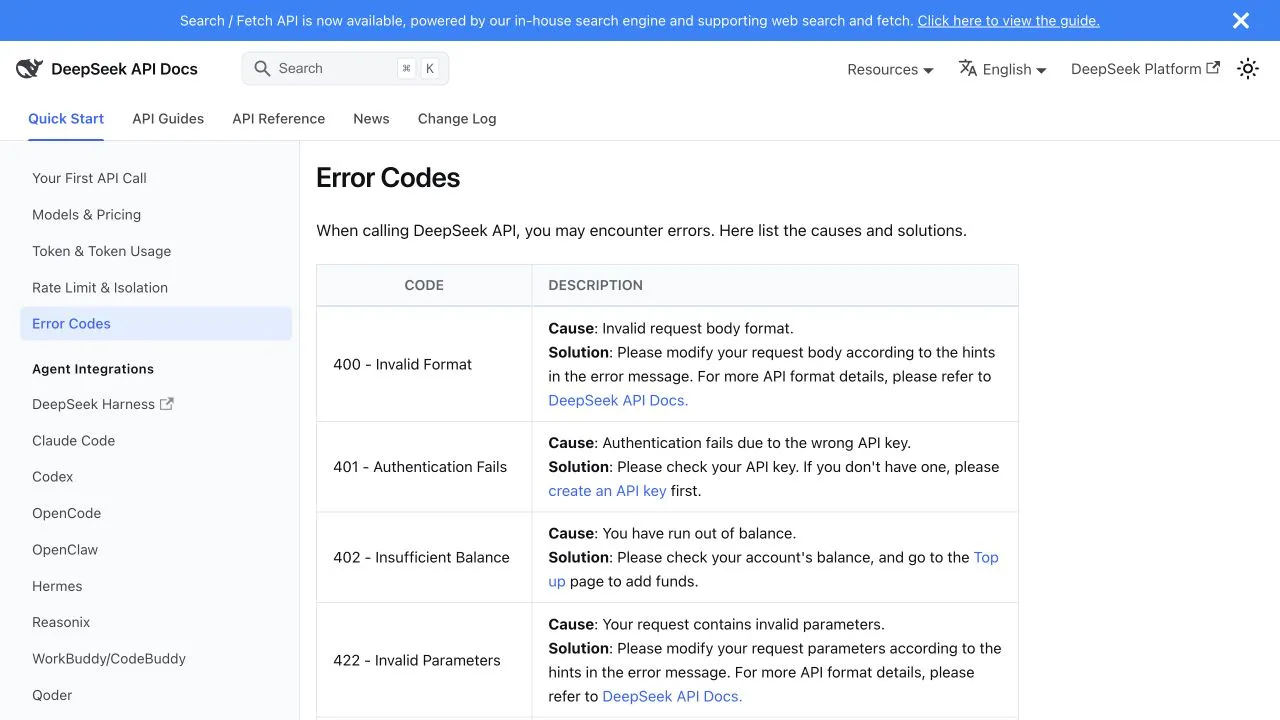
Official documentation captured October 19, 2026; this is a reference-page screenshot, not a failed API request.
The first seven categories below follow DeepSeek’s official error reference. A gateway can add its own error codes or translate upstream responses, so inspect both the HTTP status and its documented error body.
| Symptom | First action | Automatically retry or switch? |
|---|---|---|
| 400 request format error | Validate JSON, endpoint and message structure | No; repair the request |
| 401 authentication failure | Match the key to the destination account and host | No; a backup must not hide broken credentials |
| 402 insufficient balance | Inspect that provider’s balance and billing state | No; adding retries will not fund the account |
| 422 invalid parameters | Check types, output limits and model-specific options | No; fix the unsupported parameter |
| 429 rate/concurrency limit | Reduce concurrent work and respect server retry guidance | Bounded retry if it is temporary; stop if the body identifies exhausted quota |
| 500 internal error | Save request ID, retry with backoff | Limited retries, then an approved backup |
| 503 overloaded | Reduce pressure rather than sending parallel duplicates | Limited retries, then an approved backup |
| 404 or model-not-found from a gateway | Verify base path, exact model ID and account visibility | No automatic model guessing |
| 502/504 from an intermediary | Check gateway/proxy and upstream timing | Treat as potentially transient, with ambiguous-completion precautions |
| TLS, DNS, connection or read failure | Check network stage and proxy; keep certificate verification enabled | Do not assume the request was never accepted |
| HTTP 200 with blank/partial/unusable output | Inspect finish reason, content, reasoning fields and stream parser | Validate the result; do not declare success from status alone |
A 429 is not always solved by waiting. Some providers use it for exhausted credits or a hard quota. The sample stops for recognized quota codes; extend that classification with your provider’s documented error schema before production use. Likewise, a timeout is a client observation, not evidence of zero token consumption.
DeepSeek documents account-level concurrency limits and separate behavior for overloaded requests in its rate-limit guide. Measure active requests across all workers and API keys sharing the account. Slowing down only one worker may leave the account over its limit.
3. Run one small diagnostic request
For the direct DeepSeek service, the current documented Flash ID is deepseek-flash. That is not automatically the identifier on a gateway. The official API introduction identifies the current mapping; for first-time access, see our DeepSeek API setup guide.
Use a trusted shell with tracing disabled, an existing secret-store environment variable, and an empty working directory. The following request sends only a synthetic phrase. It can incur normal inference charges. Do not repeatedly run it against an overloaded service.
umask 077
curl --silent --show-error --fail-with-body \
  --connect-timeout 5 --max-time 45 \
  --dump-header response-headers.txt \
  --output response-body.json \
  --write-out 'HTTP %{http_code}; total %{time_total}s\n' \
  https://api.deepseek.com/chat/completions \
  -H "Authorization: Bearer $DEEPSEEK_API_KEY" \
  -H "Content-Type: application/json" \
  --data '{"model":"deepseek-flash","messages":[{"role":"user","content":"Reply with exactly: DIAGNOSTIC_OK"}],"stream":false,"max_tokens":128,"thinking":{"type":"disabled"}}'
The 5-second connection and 45-second total limits are deliberate diagnostic settings, not DeepSeek service guarantees. A long reasoning task may need a different deadline. --fail-with-body requires a curl version that supports it; check curl --version if the option is rejected. Do not add verbose tracing or paste the command with a real key into a ticket. Local process inspection can also expose expanded command arguments; use an SDK with your secret manager in shared environments.
A useful result is HTTP 200, a complete non-empty answer containing DIAGNOSTIC_OK, and recorded usage if returned. Examine choices[0].finish_reason; output ending because of a length limit has not met the same contract as a completed answer. Preserve sanitized error details for failures. The two files above may be overwritten on a subsequent run, so use separate directories when comparing attempts.
If this succeeds, restore your real request one feature at a time: longer history, thinking, structured output, tools, then streaming. This makes the first failing addition visible. Do not send a production conversation to a new provider merely to diagnose connectivity.
4. Decide what kind of backup actually helps
There are three different changes people call “fallback”:
| Change | What it might address | What it does not establish |
|---|---|---|
| Another gateway, same upstream | A fault in your original gateway or its network path | Independence from a DeepSeek upstream outage |
| Same DeepSeek version, another serving provider | A provider-specific capacity or serving incident | Identical parameters, safety behavior, latency or task quality |
| Another model family | Dependence on a single model or serving ecosystem | Drop-in equivalence for reasoning, images, tools or output formats |
Two API keys on the same provider account may share quota. Two model names may resolve to the same deployment. Two gateways may both call the same upstream. Record the serving provider where it is disclosed, and ask for clarification when routing is opaque. “Different URL” alone is not an independence test.
For simple summarization or extraction, a separately validated text model may be a reasonable degraded mode. For code changes, run the project’s tests against the result. For image understanding, verify the actual image input path. For a tool-using agent, preserve the system instructions, completed tool results and pending action state; do not copy provider-specific reasoning blocks blindly into another protocol.
When privacy or contractual constraints prohibit sending data to the backup, queue the task or return a clear temporary-unavailability message. Availability does not override the approved data boundary.
5. Prepare an Ofox backup with an exact model ID
Ofox’s public model catalog returned these entries on October 19. This is a catalog verification, not a successful inference test or a recommendation that one model is superior.
| Candidate model ID | Serving provider type listed | How to evaluate it |
|---|---|---|
deepseek/deepseek-v4.1-flash-1017 | volcengine | Candidate for retaining the dated DeepSeek family on a separately listed serving provider |
deepseek/deepseek-v4.1-flash | deepseek, volcengine | An undated route; the listed providers do not prove which one handled an individual request |
google/gemini-3.8-flash | google_vertex | Candidate for a different model family; recheck task quality and payload compatibility |
openai/gpt-5.4-mini | azure_foundry | Another model-family candidate; do not forward DeepSeek-only parameters unchanged |
The catalog lists OpenAI Chat Completions for these entries. It separately marks built-in web_search and web_fetch false for the two DeepSeek entries. Do not assume that direct DeepSeek Search/Fetch capabilities or billing rules travel with an Ofox model ID. This guide’s fallback uses only text Chat Completions, not provider-native search.
To prepare the route:
- Inspect the current catalog entry, supported protocol and applicable account price. This article does not quote an Ofox price or promise free use.
- If the route fits your requirements, create an Ofox account and create a key in API Keys. Follow the authentication documentation. An Ofox key and a direct DeepSeek key belong to different accounts.
- For the OpenAI-compatible route, use
https://api.ofox.io/v1as the SDK base URL. A raw HTTP call adds/chat/completionsonce. Avoid/v1/v1or attaching an Anthropic message payload to this route. - Copy the exact candidate model ID, send the non-sensitive diagnostic task, and check returned content, usage and the request record. Complete any required funding separately after checking the account terms.
- Only add it to production fallback after the representative task and cost checks below pass.
A shared Ofox gateway remains a common dependency if both primary and backup use it. If you need protection against gateway failure too, approve a route outside that gateway. We have not established operational independence or an uptime guarantee for these candidates.
6. Test bounded retries and fallback locally
Download the Python example and tests. The package contains failover.py, test_failover.py and a README. Extract it into a new directory, then run:
python3 -m venv .venv
source .venv/bin/activate
python -m pip install requests
python -m unittest -v
Our October 19 run passed 14 test methods using injected responses and synthetic credentials. No network call is made by those tests. They cover primary success, 503 recovery, backup after two failures, terminal HTTP errors, quota-versus-rate-limit 429, attempt exhaustion, ambiguous transport failure, explicit replay opt-in, TLS failure, invalid successful responses, and numeric/date Retry-After handling.
The controller permits at most two primary attempts and one backup attempt. It honors Retry-After before retrying or changing routes; a delay over its 30-second wait budget stops the example so the caller can queue the task. Without a usable header, it uses bounded randomized backoff. Redirects are disabled to avoid unintentionally changing the destination. Each route gets its own key and model.
To make actual requests, set these environment variables through your approved secret manager:
DEEPSEEK_API_KEY = your direct DeepSeek key
BACKUP_BASE_URL  = https://api.ofox.io/v1
BACKUP_MODEL     = deepseek/deepseek-v4.1-flash-1017
BACKUP_API_KEY   = your Ofox key
BACKUP_DISABLE_THINKING = 1
For the DeepSeek backup shown here, BACKUP_DISABLE_THINKING=1 explicitly disables reasoning for the short diagnostic response. If you choose another model family, remove that flag and use its documented settings and an adequate output budget; do not forward DeepSeek-only parameters automatically. This parameter configuration still needs a live route check.
Then run python failover.py. This sends a fixed text prompt and can incur charges. It prints the selected route, requested/returned model, text, usage and request ID when available. The expected answer is FALLBACK_TEST_OK; check that exact marker yourself. A normal primary success does not exercise the live backup. To validate the backup independently, send the diagnostic request directly to its documented route; do not deliberately overload or break the primary service.
Transport failures stop by default because the server may already have accepted the request. python failover.py --allow-ambiguous-replay explicitly permits another attempt for this fixed, side-effect-free text task. It is not permission to replay a tool action, payment, email or file mutation. Even pure generation can be billed twice.
The example uses Requests directly, without an SDK’s hidden status retries. If you integrate the policy into an SDK, disable its retries or count them within the same attempt budget. Its 5-second connect and 30-second read-inactivity timeouts are not an overall wall-clock deadline. Production code also needs a total deadline, shared concurrency control, persistent circuit state and task-specific output validation.
7. Handle streaming and tool execution separately
Once output has reached a user, do not append the beginning of a different model’s answer to it. Mark the first response interrupted. If the user or application restarts generation, keep the new answer separate and record both attempts. Heartbeats or whitespace arriving on a connection are not necessarily useful output; track time to meaningful content as well as connection activity.
For tools, generation and execution are separate stages. A model returning a tool call does not prove the action ran; a network interruption after your executor ran it does not prove it failed. Keep a durable action ledger containing the task ID, action arguments or a safe reference, execution status and result. Before resuming, reconcile any action whose outcome is unknown. Use downstream idempotency support where it exists; do not invent an idempotency header and assume the provider honors it.
A practical recovery sequence is: stop dispatching new actions, identify completed actions, recover their saved results, validate the pending action, then resume with the approved model. If the state cannot be reconciled safely, stop for review. The downloadable example intentionally contains no tool executor or streaming parser.
8. Accept the backup, measure its cost and return to primary
Prepare representative cases before an incident: your normal task, a long but supported input, a structured-output task if needed, and each required tool or image operation. Define correctness per case. A valid JSON object can still contain the wrong values; code can compile and still fail the required behavior.
Record the route, exact requested model, returned model if present, input size, parameters, latency, finish reason, usage, billing record and pass/fail result. Missing usage is unknown, not zero cost. A cached prompt on the primary does not establish a cache hit on the backup. Include failed and retried attempts when reconciling the bill.
Set a degraded-mode policy: which tasks can use the backup, the allowed spend, maximum attempts and what happens after failure. A simple internal summary might tolerate a different style; a financial extraction or a destructive code action may require review. Do not switch silently merely because the alternative returns faster.
For sustained failures, open a circuit for the affected route and stop sending normal traffic to it. After a cooldown, allow a small probe; after a sequence of successful representative checks, gradually restore traffic. The thresholds should follow your application deadline and risk, not a universal number from a blog. Avoid oscillating between routes after every individual failure. Keep the backup configuration available after recovery, and record the incident timeline.
If you still need support, send the timestamp, sanitized status/code, requested model, client version, request ID and a minimal synthetic reproduction. Omit keys, private prompts and customer files. For deeper client-specific issues, continue with the DeepSeek cross-client diagnostic guide; for general status meanings, use the API error reference.
Your acceptance target is concrete: one correctly diagnosed failure, a tested retry ceiling, an approved backup that completes your actual task, and a recovery path that does not duplicate actions. A catalog entry and a successful HTTP response are only steps toward that result.