Use Opus 5.5 in Claude Code: model selection and limits
Select Opus 5.5 in Claude Code, check provider and usage settings, and distinguish a conversation reset from a subscription limit reset.
 Ofox
Ofox 
Use Claude Code’s model selector to check what your account can access, then select Opus 5.5 explicitly when you need that version. The opus alias is convenient, but a model family name is not a permanent version pin. Your provider and managed configuration also matter.
This guide follows the official Claude Code model configuration, command reference and Opus 5.5 announcement, checked September 23, 2026. It covers documented setup and diagnosis, not an authenticated test of every plan or provider.
Check the client version and model before a large task
The current model configuration document requires Claude Code v2.1.280 or later for Opus 5.5. Check claude --version; use the documented claude update command if your installation needs updating. Follow your organization’s software policy for managed installations.
In an existing Claude Code session, use the documented commands:
/model
/usage
/model lets you inspect and change the active model. In the current picker, Enter switches and saves the choice as your default; pressing s switches only for this session. Typing /model <name> directly also saves the choice. Project or managed settings may take precedence on the next launch. /usage shows relevant usage information. Check the actual provider and account before assuming that the launch announcement changes an organization’s enabled models. Enterprise controls or a third-party route can differ from a direct Anthropic account.
For a direct Anthropic launch configuration, the documented model ID is claude-opus-5-5. An explicit invocation looks like:
claude --model claude-opus-5-5The command selects a model for the session; it is not proof that the account can successfully run it. Starting the CLI does not establish the price or acceptance quality of the next task. On another provider, confirm that provider’s supported identifier rather than blindly replacing a working configuration.
An alias such as opus resolves according to the environment’s current configuration. If reproducibility matters, record the resolved version and relevant settings with the task. Two reports that both say “I used Opus” may not describe the same model or workflow. The current documentation maps opus to Opus 5.5 on the Anthropic API, while the Microsoft Foundry alias remains Opus 4.6. Use the provider-specific configuration when pinning a version.
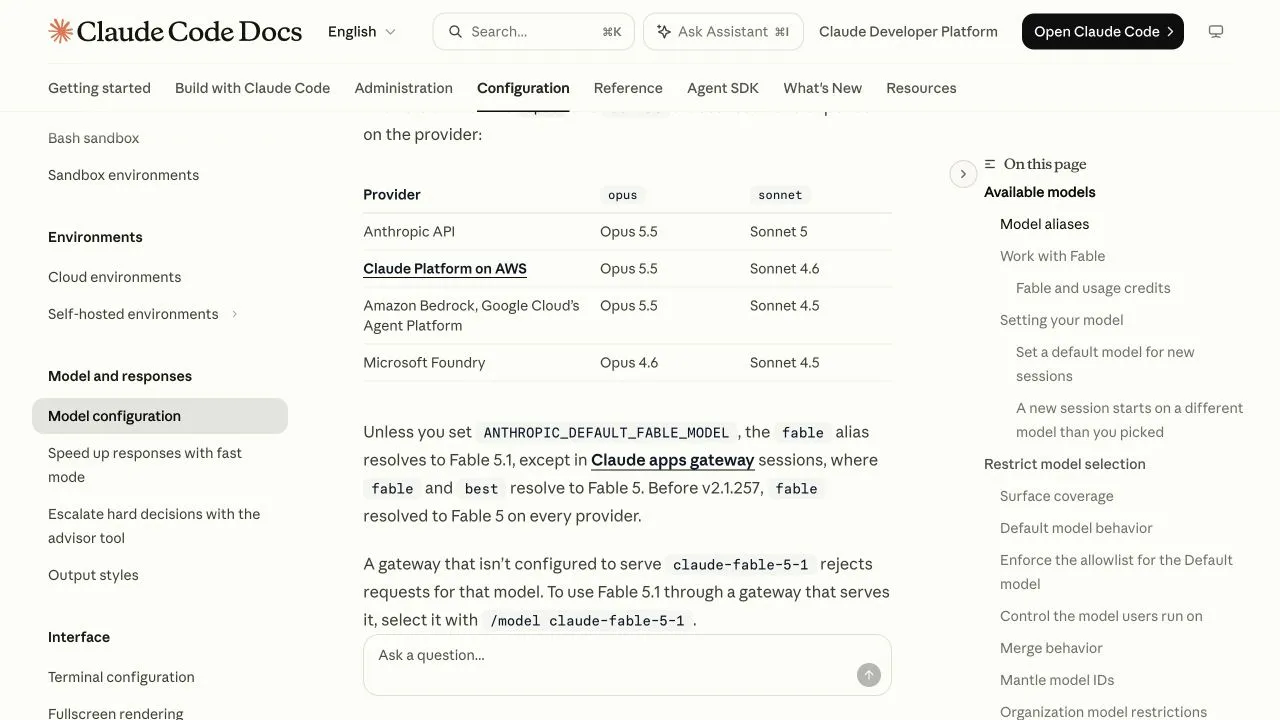
Official English documentation captured September 23, 2026. This shows the documented alias mapping, not an authenticated client session.
What the launch says about availability
Anthropic’s Opus product page lists Opus 5.5 for Pro, Max, Team and Enterprise, alongside developer access through the Claude Platform and cloud partners. That is a product-availability statement, not a guarantee that every account sees identical limits at the same moment.
The launch announcement also describes increased five-hour usage limits on Pro, Max, Team and seat-based Enterprise plans, plus a subscription rate-limit reset that can be saved. It does not mean every weekly limit disappears or that every task consumes the same fraction of an allowance.
For the reset benefit, check the actual account’s available action and terms. We did not verify a universal redemption button, expiry date or entitlement count. This guide therefore does not invent a click sequence or tell you to consume a reset merely to test whether it works.
/reset does not restore your quota
The similarly named operations solve different problems:
| Action or display | What it is for | What not to infer |
|---|---|---|
/model | Model selection | That an alias always pins Opus 5.5 |
/usage | Usage information | That an API price determines message allowance |
/cost | API cost information for a session | That it is a subscription bill |
/clear or its /reset alias | Clear the conversation | That it restores a five-hour or weekly limit |
| A subscription rate-limit reset | Account entitlement described in the launch | That clearing chat activates it |
Clearing a conversation can remove useful working context. Do it when that is your intention, not as a speculative billing fix. If you need to preserve an investigation, record its state before starting over.
Troubleshoot “not showing” in order
First, confirm you are looking at the intended product and account. Next, inspect the model selector and any managed settings. Record the Claude Code version and provider. Compare the configured identifier with the current official documentation.
If the model is listed but a request fails, preserve the actual error and request ID with secrets removed. Authentication, permissions, billing, model naming and usage limits are different causes; changing all of them at once makes diagnosis harder. A missing menu entry alone does not prove that the model was withdrawn.
If a third-party route uses provider-specific model names, keep that distinction visible. The provider-routing verification guide describes what to record before comparing results or invoices. This article does not claim that Ofox or every other gateway has already enabled the new model.
Make the first task easy to verify
For a code repository, start from a known commit and ask for a bounded change: document one function, fix a reproduced bug, or review a small diff. State the acceptance check and which files are in scope. Read the diff and run the relevant check before expanding the task.
That workflow helps you evaluate the complete setup, including repository instructions and tools. It does not assume the model’s launch claims will predict the result of your particular codebase. Preserve failed attempts as well as successful ones when deciding whether to migrate.
Use the Opus 5.5 pricing explanation to interpret the 40% cost headline. For an alternative daily coding model, the Sol versus Opus 5.5 comparison separates rate-card arithmetic from measured performance.
Frequently Asked Questions
- Which ID selects Opus 5.5?
- For the direct Anthropic model, use claude-opus-5-5. Check provider-specific identifiers and account access when using another service.
- Does /reset restore my usage allowance?
- No. In Claude Code it is an alias for clearing the conversation, not a subscription quota reset.
- Does the launch remove weekly limits?
- The announcement describes increased five-hour limits and a savable reset benefit. It does not establish unlimited usage or the removal of every other limit.