How to do market research with AI and write a report with verifiable sources
Research with Ofox Chat: define a question, classify sources, check claims and export a report. Includes a real example with inconclusive evidence.
 Ofox

Use AI market research to collect and organize evidence, then check whether each conclusion is actually supported by its sources. A report with many links can still mix advertising, old anecdotes, inaccessible posts and current product documentation. Those materials answer different questions.
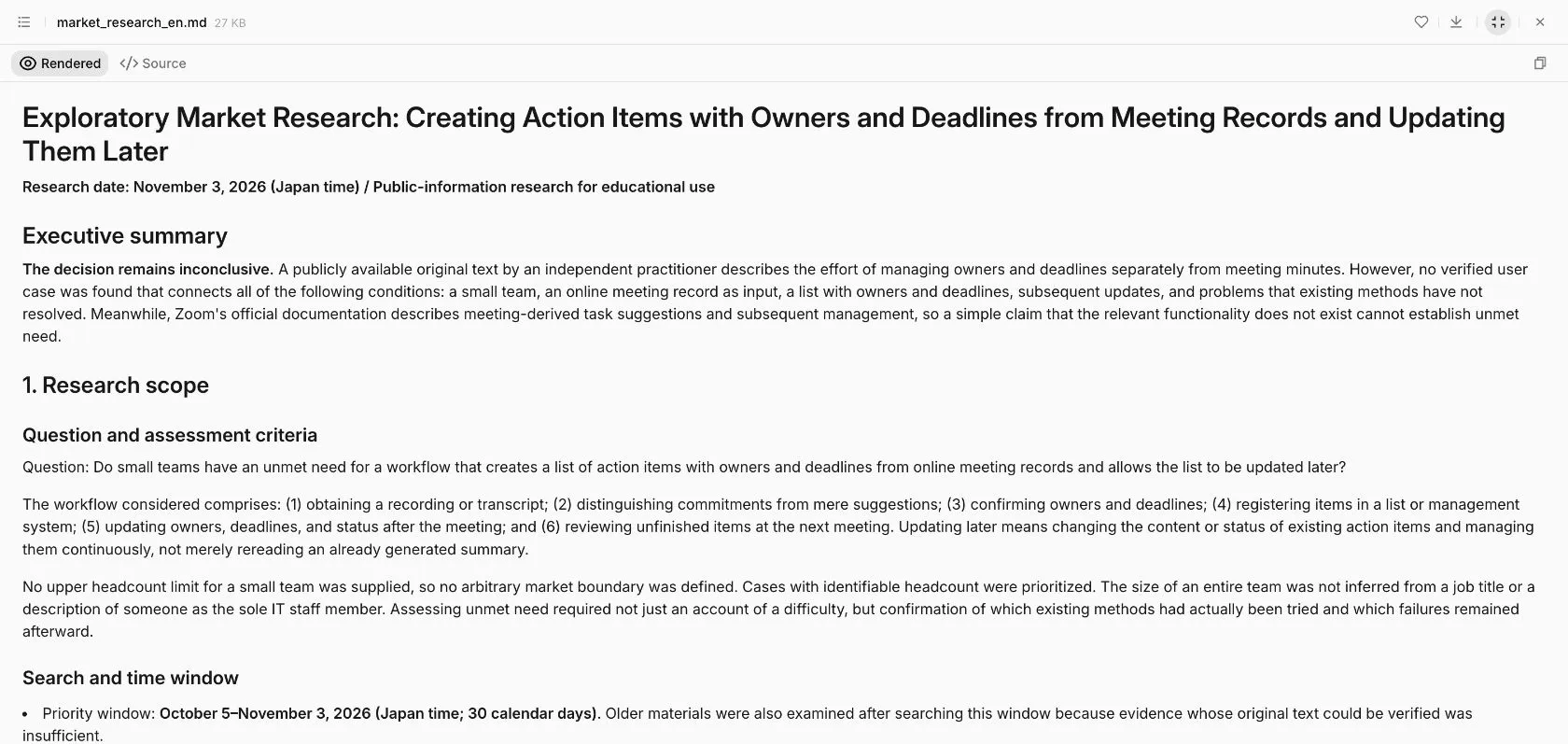
We tested Ofox Chat with a real public-source research task on November 3, 2026, using the Balanced setting. The question was whether small teams have an unmet need for turning online meeting records into an action list with owners and deadlines, then updating that list later. The generated report did not establish that unmet need. It separated the evidence and left the conclusion open.
That is a useful result for a research tutorial: it shows how to avoid presenting a plausible product idea as validated demand. This article is published by Ofox. The research example is exploratory desk research, not a representative survey, a market-size estimate or a product recommendation. The Japanese report was generated first; the Russian version was requested as an adaptation of the same evidence, not as independent Russian-market research.
Download the research example
Download the editorial worked report, the filled English source ledger, and blank source-ledger CSV. The Japanese and Russian ledgers preserve all twelve entries.
The report download is a condensed editorial teaching edition based on the actual output, not the unedited agent file. The ledger removes copied excerpts and adds a separate editorial-check column. In a separate AI-assisted editorial check, we rechecked S01, S06, S07, S08 and S10 against the original pages; other rows retain the agent’s stated status without an independent recheck. This was not a review by a human editor. Unverified candidates are not adopted as findings. Russian and English reports adapt the same research; neither is a separate local-market study.
Define a question that the evidence could disprove
“Research the AI meeting market” invites an enormous answer with unclear boundaries. A more useful question identifies a user group, a job, a stage of work and the decision the research will inform.
Our brief defined small teams, online meeting records, action extraction with owners and deadlines, and subsequent updates. The decision was whether there was enough evidence to justify further user interviews. We did not ask the agent to prove that an opportunity existed.
| Field | Example | Why it matters |
|---|---|---|
| Target user | A person coordinating a small team | A large enterprise procurement problem may not transfer |
| Task | Turn meeting records into an actionable list | This is more specific than “take better notes” |
| Continuation | Update owners, deadlines and completion later | Extraction alone does not cover the full workflow |
| Evidence window | Recent 30 days preferred; older material labeled | Old friction is not automatically current demand |
| Decision | Identify what to investigate next | A handful of posts cannot establish market size |
| Disconfirming evidence | Existing products already solve part of the task | Research must allow the initial idea to weaken |
For a different project, change the target job and decision together. A purchase comparison requires current plan restrictions and hands-on evaluation; a demand investigation needs independent descriptions of actual work and workarounds. Do not use a vendor feature page to answer whether users will pay.
Run a research brief that preserves uncertainty
Open Ofox Chat and enter the brief in a new conversation. We used the ordinary chat composer rather than assuming a special research-mode switch. Sign-in and adequate account balance are required. Use only public information or private material you are authorized to process.
The following template preserves the important constraints from our test:
Write an exploratory market research report in [output language].
Question: Do small teams have an unmet need for turning online meeting
records into an action list with owners and deadlines, then updating it?
This is public-source desk research, not a statistical market estimate.

Search public web sources. Distinguish independent users describing
specific work from official product documentation and promotional content.
Prefer the last 30 days. If older material is needed, label its date.
If you cannot read the original, mark it unverified.
Do not treat a search snippet or a repost as the original source.

Deliver:
1. Scope and research question
2. Source table: URL, title, publication date or unknown, checked date,
   source type, claim supported, original-reading status and limitations
3. Specific workflow problems
4. Existing workarounds and remaining questions
5. Facts separated from hypotheses, including counterevidence
6. Follow-up interview questions

Check that the original text supports the claim, not just that the link opens.
Do not invent market size, frequency, willingness to pay or time savings.
An inconclusive result is acceptable. Provide a downloadable Markdown
report and a CSV source table.
If the agent returns only a fluent summary, ask for the source table before accepting the conclusion. If its available tools cannot retrieve a page, keep that limitation in the report. You can supply approved documents manually, but that becomes analysis of supplied material, not proof that autonomous web research succeeded.
Classify sources before counting them
The initial output contained twelve source entries. Twelve entries did not mean twelve verified user cases. Some entries were official documentation; some were inaccessible candidates; one was a repost of another entry. Counting all of them as independent evidence would exaggerate the finding.
Use categories that preserve what a source can establish:
| Source type | It may support | It does not establish by itself |
|---|---|---|
| Independent first-person account | A described task, difficulty or workaround | How common the difficulty is |
| Official product documentation | A stated feature and its conditions | User satisfaction, accuracy or demand |
| Vendor announcement | What the vendor announced at that date | Complete current availability or measured benefits |
| Builder or affiliate promotion | The author’s product positioning | Independent customer validation |
| Search snippet or inaccessible original | A candidate for follow-up | A verified quotation or fully supported claim |
| Repost of an existing thread | A route to finding the original | Another independent user case |
Also distinguish publication date from the date you checked the page. An undated support page checked today is not a newly published article. A date inside a URL is not sufficient evidence of publication date. For the November 3 run, the requested recent window was October 5–November 3, but older sources remained explicitly labeled.
What the real example did—and did not—show
A Japanese practitioner’s meeting-notes essay dated May 2, 2022 describes a tradeoff: note-style minutes need separate owner/deadline management, while ticket-style minutes require navigating between tickets during a meeting. We independently retrieved the original page and checked that distinction. It is evidence of one author’s workflow reasoning, not a recent failure case involving a known small online team.
The official Zoom AI task documentation describes task recommendations from meeting material and adding assignees. Its dashboard documentation describes deadline and completion management. These pages have account, enablement and application requirements. We checked the documentation, not the live Zoom workflow. Their existence is enough to reject the simplistic claim that no existing product covers these steps; it does not prove that they solve every team’s needs.
An Otter announcement dated August 22, 2024 describes extracting and aggregating action items, with links to the relevant conversation context. We used it as a dated vendor statement, not as a full audit of Otter’s current functionality. Neither its promotional benefits nor its past availability language becomes evidence of present-day customer outcomes.
Other candidates remained unverified in the generated ledger. A Reddit thread and its repost were kept separate, with the original-reading limitation recorded. A recent developer article about the author’s own project was classified as promotion rather than an independent user’s complaint. These distinctions prevented an attractive but unsupported “the market is underserved” conclusion.
The defensible finding is narrower: there is documented workflow friction, and existing products address parts of the workflow. The evidence gathered in this run does not demonstrate that small teams currently have a recurring, unresolved problem across the whole sequence. It also says nothing reliable about market size or willingness to pay.
Check claims against the original pages
Do not review only the report’s bibliography. Review the claims that drive its conclusion. For each one, open the source and find the passage that actually supports it. Record a short paraphrase and a precise section reference; long copied passages are unnecessary.
For example:
| Proposed claim | Evidence check | Appropriate treatment |
|---|---|---|
| “Meeting notes can leave owner/deadline tracking separate” | The 2022 practitioner essay explicitly discusses that tradeoff | Attribute it to that author and date |
| “Existing products cannot manage follow-up” | Zoom’s official pages describe related functions | Reject the blanket claim |
| “This is common among small teams” | The confirmed practitioner source does not establish team size or prevalence | Keep unknown |
| “Users will pay for a new workflow” | No payment or switching evidence was established | Do not include as a finding |
| “A generated due date reflects a meeting agreement” | Product documentation describing generation does not prove this | Require transcript and user verification |
A page returning HTTP 200 is not enough if the meaningful body is missing. Conversely, one retrieval failure does not prove the information is false. Mark it as unverified and explain the scope of the failure. Where we could independently retrieve an original through another ordinary public reading method, we checked the content; we did not bypass a login or access restriction.
Preserve disagreements. If a user says their workflow is painful while a product says the feature exists, investigate configuration, plan eligibility, extraction accuracy, adoption and handoff. Do not resolve that tension by automatically assuming either the user or the vendor is wrong.
Turn evidence into a report a colleague can review
A useful report makes the route from evidence to conclusion visible. Keep a small number of sections with distinct jobs:
- Question and scope: who, what task, which sources and dates, and which decisions the report can support.
- Observed facts: attributed statements with source IDs, including qualifications.
- Existing approaches: what people or documented products already do; distinguish documentation review from hands-on testing.
- Hypotheses: interpretations that need more evidence, not observations disguised as facts.
- Unknowns and counterevidence: unread originals, missing demographics, older evidence and conflicting information.
- Next research step: questions that would change the conclusion.
For our example, useful interview questions include: “Show the last meeting where an action became unclear”; “Where did the owner and deadline end up?”; “What happened when that deadline changed?”; and “Which existing tool did you try, and what specifically failed?” These questions ask about completed behavior. Asking only whether someone likes an imagined AI feature produces weaker evidence.
A negative or inconclusive result is still deliverable if it explains what was checked and what remains open. Do not pad the findings with invented numbers to make the report seem finished.
Export, localize and recheck the evidence trail
The test produced a Markdown report and CSV source ledger. Download both, open them and confirm that source IDs, URLs, status labels and the conclusion match. A CSV can be opened in a spreadsheet application for filtering by source type and verification status. Preserve URLs as text and check encoding before handing it to a colleague.
For another language, request a full adaptation with the same source IDs and links. Keep the original source’s language visible, and label a translated explanation as a translation rather than putting it in quotation marks as if it were the original wording. Our Russian output uses the Japanese/English research corpus; it must not be described as a study of Russian users.
For public sharing, shorten copied excerpts and prefer attributed paraphrases. Keep an unedited test output privately as evidence and label any editorial corrections in a distributed example. A reader should be able to distinguish the agent’s result from subsequent fact checking.
If your input is a set of reports already collected, the multiple-PDF workflow covers file coverage and page references. If you need a structured feature comparison rather than a demand investigation, use the competitor-research table tutorial. Once the report’s claims are checked, the AI presentation workflow can turn the approved material into slides.
Common failures and how to correct them
| Failure | Correction |
|---|---|
| Sources are mostly vendor articles | Label them as supply-side evidence and request independent workflow descriptions; do not manufacture a quota |
| The report treats search snippets as quotations | Mark originals unread and remove the claim from confirmed findings |
| Old examples become “current demand” | Keep original dates and seek recent corroboration before generalizing |
| A long bibliography disguises weak evidence | Count independent relevant cases after deduplication, not URLs |
| The conclusion is stronger than the source table | Rewrite it to the strongest supported statement, including “inconclusive” |
| Localization drops uncertainty | Compare source IDs, dates, unknowns and the final conclusion against the original |
| There are no downloadable files | Ask for the named report and ledger, then verify both file contents |
Use Ofox Chat to repeat the method with one bounded business question. The value is a traceable report and a better next research decision—not a confident answer obtained by ignoring missing evidence.